
SQL加强
SQL执行顺序
Section titled “SQL执行顺序”--举例:select a.sex, b.city, count(1) as cnt, sum(salary) as sum1from table1 ajoin table2 b on a.id=b.idwhere a.name=b.namegroup by a.sex,b.cityhaving cnt>=2order by a.sex,b.citylimit 10--或者是select distinct a.sex, b.city, a.agefrom table1 ajoin table2 b on a.id=b.idwhere a.name=b.nameorder by a.sex,b.citylimit 10上面的SQL语句的执行顺序是: from (去加载table1 和 table2这2个表 ) -> join -> on -> where -> group by->select 后面的聚合函数count,sum -> having -> distinct -> order by -> limit
--on 和where的先后顺序讨论--下面用left join 各得到结果,结果不一样。--下面可知,先执行on,再执行whereselect *from table1 aleft join table2 bon a.id=b.idwhere a.name=b.name;--下面的条数可能会比上面多。select *from table1 aleft join table2 bon a.id=b.idand a.name=b.name;--下面用inner join 各得到结果,结果是一样的select *from table1 ajoin table2 bon a.id=b.idwhere a.name=b.name;select *from table1 ajoin table2 bon a.id=b.idand a.name=b.name;hivesql与sparkSQL的区别:
- 子查询hive必须起别名,SparkSQL可以不用起别名
- group by xx,yy,hive不用能用别名,spark可以用别名
- hive不支持临时视图和缓存表,SparkSQL都支持
--用SparkSQL的临时视图use interview_db;create or replace temporary view t_view1 asselect *,if(month=1,amount,0) as a1,if(month=2,amount,0) as a2,if(month=3,amount,0) as a3,if(month=4,amount,0) as a4from table2;select year, sum(a1) as m1, sum(a2) as m2, sum(a3) as m3, sum(a4) as m4 from t_view1 group by year;
--使用SparkSQL的缓存表cache table cached1 asselect *,if(month=1,amount,0) as a1,if(month=2,amount,0) as a2,if(month=3,amount,0) as a3,if(month=4,amount,0) as a4from table2;select * from cached1;select year,sum(a1) as m1,sum(a2) as m2,sum(a3) as m3,sum(a4) as m4from cached1group by year;
- 爆炸函数,hive不支持explode与普通字段联合使用,需要用侧视图分开,SparkSQL支持联合使用
sqluse interview_db;select qq,game1 from tableB lateral view explode(split(game,'_')) view1 as game1 ;--spark还支持这样,但是hive不支持:select qq,explode(split(game,'_')) game1 from tableB ;
- sparkSQL支持300多种函数,hiveSQL支持200多种函数。sparkSQL函数比hiveSQL要多。
- 比如SparkSQL有sequence,count_if函数,hive就没有
hive10题
Section titled “hive10题”- 先配置环境
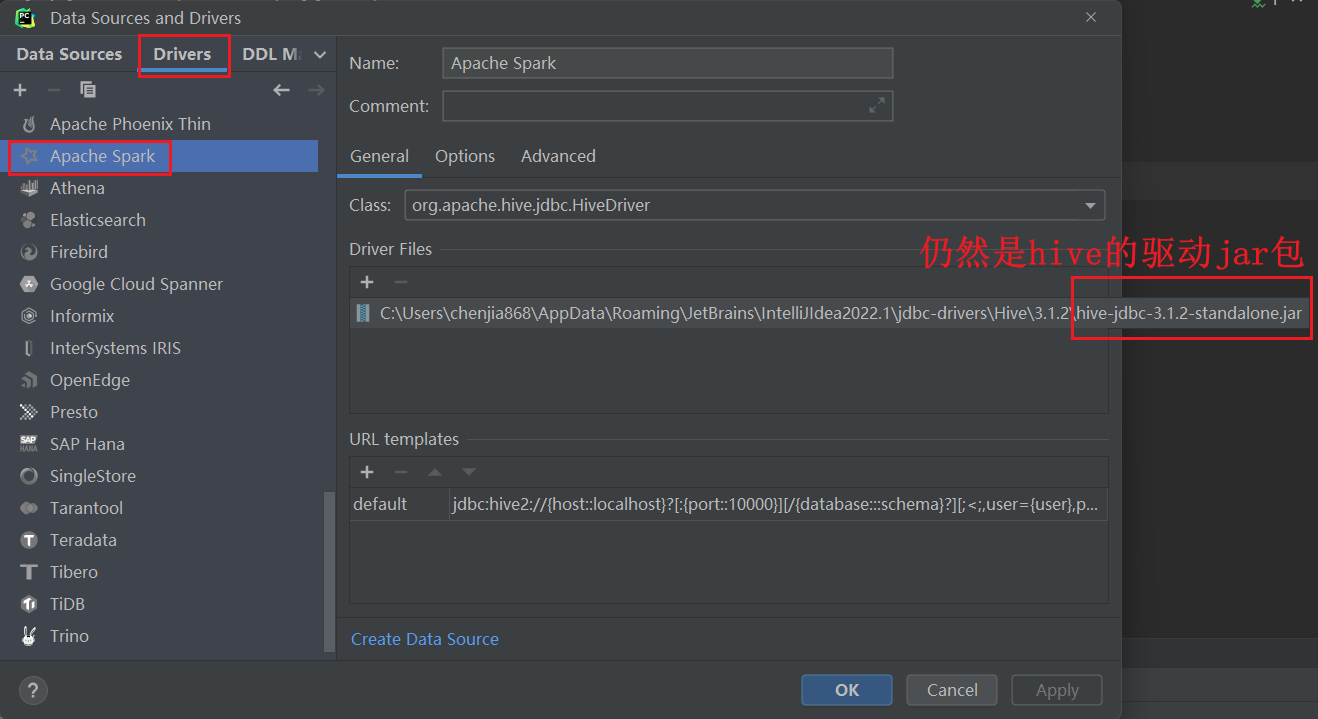
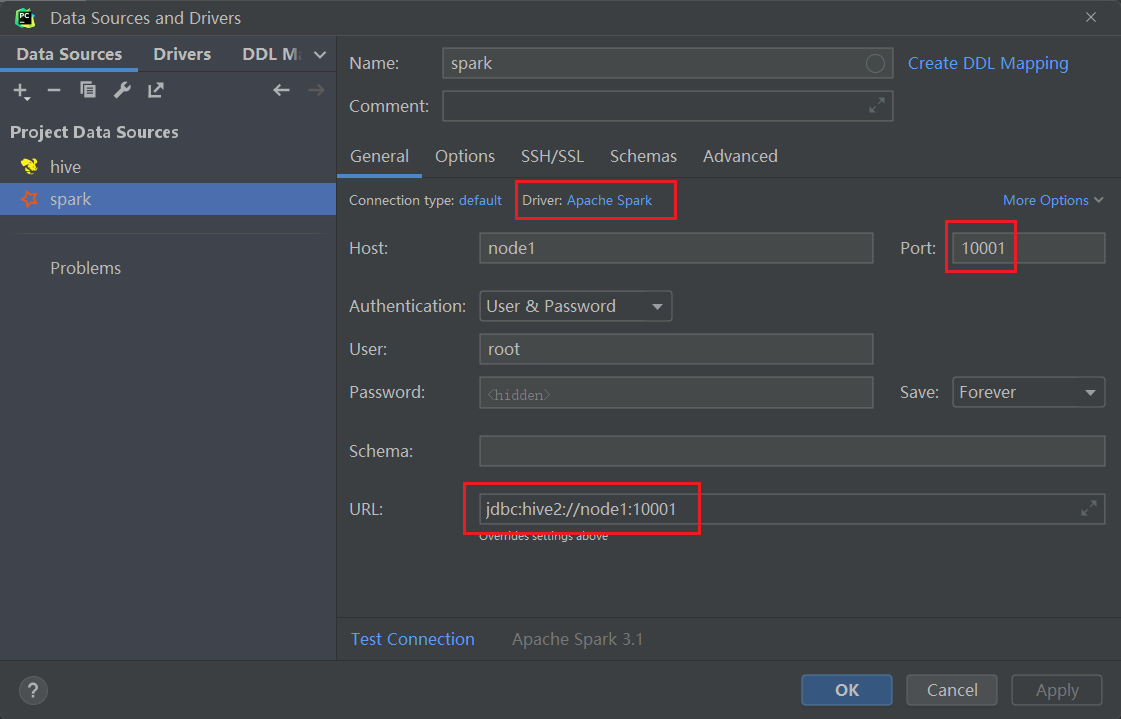
- 在pycharm或datagrip或idea中配置hive数据源。也可以配置一个sparkSQL数据源,来加快速度。
- 如果配置hive数据源:
- 需要提前启动hdfs和yarn,hive的metastore,hive的hiveserver2
#启动hdfs和yarnstart-all.sh# hive的metastorenohup /export/server/hive/bin/hive --service metastore 2>&1 > /tmp/hive-metastore.log &#hive的hiveserver2#hiveserver2开启后,等过2分钟后才能生效。nohup /export/server/hive/bin/hive --service hiveserver2 2>&1 > /tmp/hive-hiveserver2.log &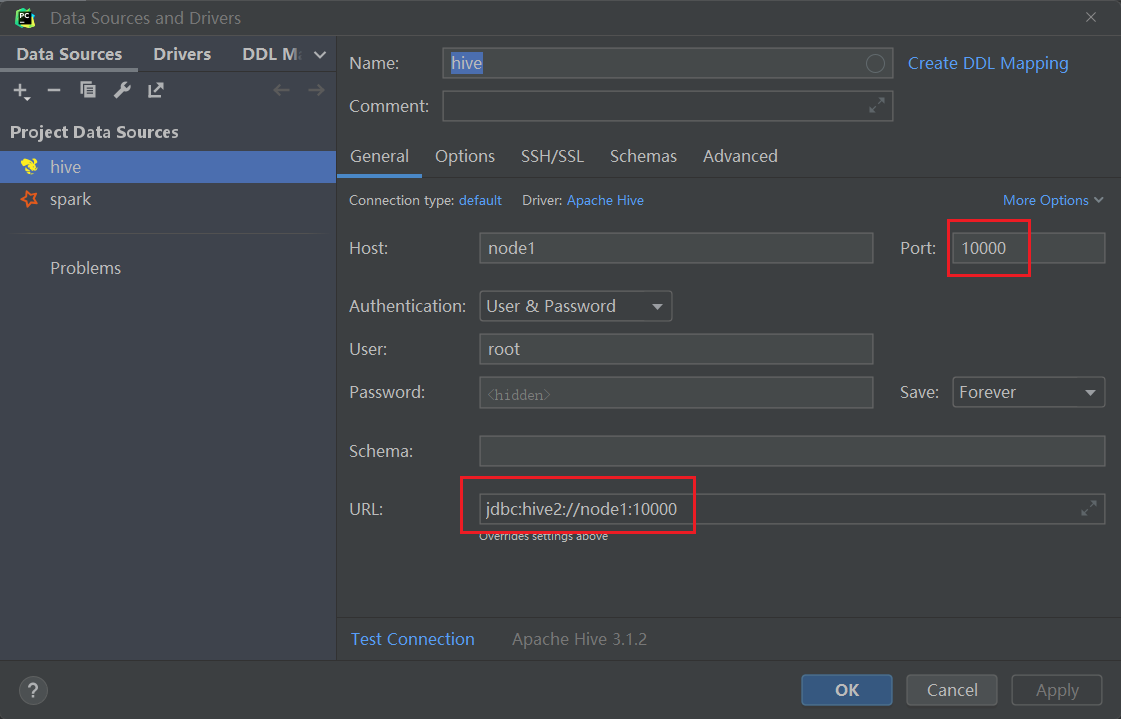
- 如果遇到下面的问题

- 解决办法
hive/conf/hive-env.sh中加入export HADOOP_CLIENT_OPTS=" -Xmx512m"export HADOOP_HEAPSIZE=1024改完重启hiveserver2- 如果配置SparkSQL数据源
- 需要提前启动hdfs,hive的metastore,Spark的Thriftserver服务。
#启动hdfs和yarnstart-all.sh# hive的metastorenohup /export/server/hive/bin/hive --service metastore 2>&1 > /tmp/hive-metastore.log &#Spark的Thriftserver服务/export/server/spark/sbin/start-thriftserver.sh \ --hiveconf hive.server2.thrift.port=10001 \ --hiveconf hive.server2.thrift.bind.host=node1 \ --master local[*]- 下面是spark3集成hive3需要的jar包,如果是spark2集成hive2,则jar包不一样。
show databases ;create database if not exists test_sql;use test_sql;-- 一些语句会走 MapReduce,所以慢。 可以开启本地化执行的优化。set hive.exec.mode.local.auto=true;-- (默认为false)--第1题:访问量统计CREATE TABLE test_sql.test1 ( userId string, visitDate string, visitCount INT ) ROW format delimited FIELDS TERMINATED BY "\t";INSERT overwrite TABLE test_sql.test1VALUES ( 'u01', '2017/1/21', 5 ), ( 'u02', '2017/1/23', 6 ), ( 'u03', '2017/1/22', 8 ), ( 'u04', '2017/1/20', 3 ), ( 'u01', '2017/1/23', 6 ), ( 'u01', '2017/2/21', 8 ), ( 'u02', '2017/1/23', 6 ), ( 'u01', '2017/2/22', 4 );select *, sum(sum1) over(partition by userid order by month1 /*rows between unbounded preceding and current row*/ ) as `累积` from(select userid, date_format(replace(visitdate,'/','-'),'yyyy-MM') as month1, sum(visitcount) sum1from test_sql.test1group by userid, date_format(replace(visitdate,'/','-'),'yyyy-MM')) as t;-- 第2题:电商场景TopK统计CREATE TABLE test_sql.test2 ( user_id string, shop string ) ROW format delimited FIELDS TERMINATED BY '\t';INSERT INTO TABLE test_sql.test2 VALUES( 'u1', 'a' ),( 'u2', 'b' ),( 'u1', 'b' ),( 'u1', 'a' ),( 'u3', 'c' ),( 'u4', 'b' ),( 'u1', 'a' ),( 'u2', 'c' ),( 'u5', 'b' ),( 'u4', 'b' ),( 'u6', 'c' ),( 'u2', 'c' ),( 'u1', 'b' ),( 'u2', 'a' ),( 'u2', 'a' ),( 'u3', 'a' ),( 'u5', 'a' ),( 'u5', 'a' ),( 'u5', 'a' );--(1)每个店铺的UV(访客数)-- UV和PV-- PV是访问当前网站所有的次数-- UV是访问当前网站的客户数(需要去重)--(2)每个店铺访问次数top3的访客信息。输出店铺名称、访客id、访问次数select shop, count(distinct user_id) as uvfrom test_sql.test2 group by shop ;--上面的拆解来看,等价于--distinct后可以接多个字段,表示联合去重select shop, count(user_id) as uvfrom(select distinct shop, user_idfrom test_sql.test2 ) as tgroup by shop ;--也等价于select shop, count(user_id) as uvfrom(select shop, user_idfrom test_sql.test2 group by shop, user_id) as tgroup by shop ;select * from(select *, row_number() over (partition by shop order by cnt desc) as rnfrom(select shop,user_id,count(1) as cnt from test_sql.test2 group by shop,user_id ) as t) t2where t2.rn<=3;-- 第3题:订单量统计CREATE TABLE test_sql.test3 ( dt string, order_id string, user_id string, amount DECIMAL ( 10, 2 ) )ROW format delimited FIELDS TERMINATED BY '\t';INSERT overwrite TABLE test_sql.test3 VALUES ('2017-01-01','10029028','1000003251',33.57), ('2017-01-01','10029029','1000003251',33.57), ('2017-01-01','100290288','1000003252',33.57), ('2017-02-02','10029088','1000003251',33.57), ('2017-02-02','100290281','1000003251',33.57), ('2017-02-02','100290282','1000003253',33.57), ('2017-11-02','10290282','100003253',234), ('2018-11-02','10290284','100003243',234);-- (1)给出 2017年每个月的订单数、用户数、总成交金额。-- (2)给出2017年11月的新客数(指在11月才有第一笔订单)select date_format(dt,'yyyy-MM') as month1, count(distinct order_id) as cnt1, count(distinct user_id) as cnt2, sum(amount) as amt from test_sql.test3 where year(dt)=2017group by date_format(dt,'yyyy-MM');select count(user_id) cnt from(select user_id, min(date_format(dt,'yyyy-MM')) min_monthfrom test3 group by user_id) as t where min_month='2017-11';--统计每个月的新客户数select min_month, count(user_id) cntfrom (select user_id, min(date_format(dt, 'yyyy-MM')) min_month from test3 group by user_id) as tgroup by min_month;-- 第4题:大数据排序统计CREATE TABLE test_sql.test4user (user_id string,name string,age int);CREATE TABLE test_sql.test4log (user_id string,url string);INSERT INTO TABLE test_sql.test4user VALUES('001','u1',10),('002','u2',15),('003','u3',15),('004','u4',20),('005','u5',25),('006','u6',35),('007','u7',40),('008','u8',45),('009','u9',50),('0010','u10',65);INSERT INTO TABLE test_sql.test4log VALUES('001','url1'),('002','url1'),('003','url2'),('004','url3'),('005','url3'),('006','url1'),('007','url5'),('008','url7'),('009','url5'),('0010','url1');select * from test_sql.test4user ;select * from test_sql.test4log ;--有一个5000万的用户文件(user_id,name,age),-- 一个2亿记录的用户看电影的记录文件(user_id,url),根据年龄段观看电影的次数进行排序?--取整函数有 round,floor,ceilselect *, round(x,0) as r,--四舍五入 floor(x) as f,--向下取整 ceil(x) as c--向上取整 from(select 15/10 as x union allselect 18/10 as x union allselect 24/10 as x union allselect 27/10 as x ) as t;select type, sum(cnt) as sum1from(select *, concat(floor(age/10)*10,'-',floor(age/10)*10+10) as typefrom test_sql.test4user as a-- join前最好提前减小数据量join (select user_id,count(url) as cnt from test_sql.test4log group by user_id) as bon a.user_id=b.user_id) as tgroup by typeorder by sum(cnt) desc;-- 第5题:活跃用户统计CREATE TABLE test5(dt string,user_id string,age int)ROW format delimited fields terminated BY ',';INSERT overwrite TABLE test_sql.test5 VALUES ('2019-02-11','test_1',23),('2019-02-11','test_2',19),('2019-02-11','test_3',39),('2019-02-11','test_1',23),('2019-02-11','test_3',39),('2019-02-11','test_1',23),('2019-02-12','test_2',19),('2019-02-13','test_1',23),('2019-02-15','test_2',19),('2019-02-16','test_2',19);select * from test_sql.test5 order by dt,user_id;--有日志如下,请写出代码求得所有用户和活跃用户的总数及平均年龄。(活跃用户指连续两天都有访问记录的用户)-- type 总数 平均年龄-- '所有用户' 3 27-- '活跃用户' 1 19with t1 as (select distinct dt, user_id,age from test_sql.test5), t2 as (select *,row_number() over (partition by user_id order by dt) as rn from t1 ), t3 as (select *,date_sub(dt,rn) as dt2 from t2), t4 as (select dt2,user_id,age,count(1) cnt from t3 group by dt2,user_id,age), t5 as (select * from t4 where cnt>=2), t6 as (select distinct user_id,age from t5)select '所有用户' as type, count(user_id) cnt,avg(age) as avg_agefrom (select distinct user_id,age from test_sql.test5) t union allselect '活跃用户' as type, count(user_id) cnt,avg(age) as avg_age from t6;-- 用思路2来分析连续2天登录with t1 as (select distinct dt, user_id from test_sql.test5), t2 as (select *, date_add(dt,1) as dt2, lead(dt,1)over(partition by user_id order by dt) as dt3 from t1)select count(distinct user_id) from t2 where dt2=dt3;-- 第6题:电商购买金额统计实战CREATE TABLE test_sql.test6 ( userid string, money decimal(10,2), paymenttime string, orderid string);INSERT INTO TABLE test_sql.test6 VALUES('001',100,'2017-10-01','123'),('001',200,'2017-10-02','124'),('002',500,'2017-10-01','125'),('001',100,'2017-11-01','126');select * from test_sql.test6 order by userid,paymenttime;--请用sql写出所有用户中在今年10月份第一次购买商品的金额,select userid,paymenttime,moneyfrom(select *, row_number() over (partition by userid order by paymenttime) as rn from test_sql.test6 where date_format(paymenttime,'yyyy-MM')='2017-10' ) as twhere t.rn=1;-- 第7题:教育领域SQL实战CREATE TABLE test_sql.book(book_id string, `SORT` string, book_name string, writer string, OUTPUT string, price decimal(10,2));INSERT INTO TABLE test_sql.book VALUES('001','TP391','信息处理','author1','机械工业出版社','20'),('002','TP392','数据库','author12','科学出版社','15'),('003','TP393','计算机网络','author3','机械工业出版社','29'),('004','TP399','微机原理','author4','科学出版社','39'),('005','C931','管理信息系统','author5','机械工业出版社','40'),('006','C932','运筹学','author6','科学出版社','55');CREATE TABLE test_sql.reader (reader_id string, company string, name string, sex string, grade string, addr string);INSERT INTO TABLE test_sql.reader VALUES('0001','阿里巴巴','jack','男','vp','addr1'),('0002','百度','robin','男','vp','addr2'),('0003','腾讯','tony','男','vp','addr3'),('0004','京东','jasper','男','cfo','addr4'),('0005','网易','zhangsan','女','ceo','addr5'),('0006','搜狐','lisi','女','ceo','addr6');CREATE TABLE test_sql.borrow_log(reader_id string, book_id string, borrow_date string);INSERT INTO TABLE test_sql.borrow_log VALUES ('0001','002','2019-10-14'),('0002','001','2019-10-13'),('0003','005','2019-09-14'),('0004','006','2019-08-15'),('0005','003','2019-10-10'),('0006','004','2019-17-13');select * from test_sql.book;select * from test_sql.reader;select * from test_sql.borrow_log;--(8)考虑到数据安全的需要,需定时将“借阅记录”中数据进行备份,请使用一条SQL语句,-- 在备份用户bak下创建与“借阅记录”表结构完全一致的数据表BORROW_LOG_BAK.-- 井且将“借阅记录”中现有数据全部复制到BORROW_L0G_ BAK中。create table test_sql.BORROW_LOG_BAK as select * from test_sql.borrow_log;select * from test_sql.BORROW_LOG_BAK;--(9)现在需要将原Oracle数据库中数据迁移至Hive仓库,-- 请写出“图书”在Hive中的建表语句(Hive实现,提示:列分隔符|;-- 数据表数据需要外部导入:分区分别以month_part、day_part 命名)CREATE TABLE test_sql.book2( book_id string, `SORT` string, book_name string, writer string, OUTPUT string, price decimal(10, 2))partitioned by (month_part string,day_part string ) row format delimited fields terminated by '|';--(10)Hive中有表A,现在需要将表A的月分区 201505 中-- user_id为20000的user_dinner字段更新为bonc8920,其他用户user_dinner字段数据不变,-- 请列出更新的方法步骤。(Hive实现,提示:Hive中无update语法,请通过其他办法进行数据更新)--A-- user_id user_dinner part-- 20000 aaaaa 201505-- 30000 bbbbb 201505create table A (user_id int,user_dinner string) partitioned by (part string);insert overwrite table A partition (part = '201505')values (20000, 'aaaaa'), (30000, 'bbbbb'), (40000, 'ccccc');select * from A;--update A set user_dinner='bonc8920' where user_id=20000;insert overwrite table A partition (part = '201505')select user_id, 'bonc8920' as user_dinner from A where user_id=20000 and part = '201505' union allselect user_id, user_dinner from A where user_id!=20000 and part = '201505' ;-- 第8题:服务日志SQL统计CREATE TABLE test_sql.test8(`date` string, interface string, ip string);INSERT INTO TABLE test_sql.test8 VALUES('2016-11-09 11:22:05','/api/user/login','110.23.5.23'),('2016-11-09 11:23:10','/api/user/detail','57.3.2.16'),('2016-11-09 23:59:40','/api/user/login','200.6.5.166'),('2016-11-09 11:14:23','/api/user/login','136.79.47.70'),('2016-11-09 11:15:23','/api/user/detail','94.144.143.141'),('2016-11-09 11:16:23','/api/user/login','197.161.8.206'),('2016-11-09 12:14:23','/api/user/detail','240.227.107.145'),('2016-11-09 13:14:23','/api/user/login','79.130.122.205'),('2016-11-09 14:14:23','/api/user/detail','65.228.251.189'),('2016-11-09 14:15:23','/api/user/detail','245.23.122.44'),('2016-11-09 14:17:23','/api/user/detail','22.74.142.137'),('2016-11-09 14:19:23','/api/user/detail','54.93.212.87'),('2016-11-09 14:20:23','/api/user/detail','218.15.167.248'),('2016-11-09 14:24:23','/api/user/detail','20.117.19.75'),('2016-11-09 15:14:23','/api/user/login','183.162.66.97'),('2016-11-09 16:14:23','/api/user/login','108.181.245.147'),('2016-11-09 14:17:23','/api/user/login','22.74.142.137'),('2016-11-09 14:19:23','/api/user/login','22.74.142.137');select * from test_sql.test8;--求11月9号下午14点(14-15点),访问/api/user/login接口的top10的ip地址select ip, count(1) cntfrom test_sql.test8where date_format(`date`, 'yyyy-MM-dd HH') = '2016-11-09 14' and interface = '/api/user/login'group by iporder by cnt desclimit 10;-- 第9题:充值日志SQL实战CREATE TABLE test_sql.test9( dist_id string COMMENT '区组id', account string COMMENT '账号', `money` decimal(10,2) COMMENT '充值金额', create_time string COMMENT '订单时间');INSERT INTO TABLE test_sql.test9 VALUES ('1','11',100006,'2019-01-02 13:00:01'), ('1','22',110000,'2019-01-02 13:00:02'), ('1','33',102000,'2019-01-02 13:00:03'), ('1','44',100300,'2019-01-02 13:00:04'), ('1','55',100040,'2019-01-02 13:00:05'), ('1','66',100005,'2019-01-02 13:00:06'), ('1','77',180000,'2019-01-03 13:00:07'), ('1','88',106000,'2019-01-02 13:00:08'), ('1','99',100400,'2019-01-02 13:00:09'), ('1','12',100030,'2019-01-02 13:00:10'), ('1','13',100003,'2019-01-02 13:00:20'), ('1','14',100020,'2019-01-02 13:00:30'), ('1','15',100500,'2019-01-02 13:00:40'), ('1','16',106000,'2019-01-02 13:00:50'), ('1','17',100800,'2019-01-02 13:00:59'), ('2','18',100800,'2019-01-02 13:00:11'), ('2','19',100030,'2019-01-02 13:00:12'), ('2','10',100000,'2019-01-02 13:00:13'), ('2','45',100010,'2019-01-02 13:00:14'), ('2','78',100070,'2019-01-02 13:00:15');select * from test_sql.test9 order by dist_id , money desc;--请写出SQL语句,查询充值日志表2019年01月02号每个区组下充值额最大的账号,要求结果:--区组id,账号,金额,充值时间select * from(select *, row_number() over (partition by dist_id order by money desc) rnfrom test_sql.test9 where to_date(create_time)='2019-01-02') twhere t.rn=1;-- 第10题:电商分组TopK实战CREATE TABLE test_sql.test10( `dist_id` string COMMENT '区组id', `account` string COMMENT '账号', `gold` int COMMENT '金币');INSERT INTO TABLE test_sql.test10 VALUES ('1','77',18), ('1','88',106), ('1','99',10), ('1','12',13), ('1','13',14), ('1','14',25), ('1','15',36), ('1','16',12), ('1','17',158), ('2','18',12), ('2','19',44), ('2','10',66), ('2','45',80), ('2','78',98);select * from test_sql.test10;select * from(select *, row_number() over (partition by dist_id order by gold desc) rnfrom test_sql.test10 ) twhere t.rn<=10;行转列(转置)
Section titled “行转列(转置)”- 行转列的常规做法是,group by+sum(if())【或count(if())】
与行转列,对应相反的是,列转行,此时用explode+侧视图
已知
| year | month | amount | | --- | --- | --- | | 1991 | 1 | 1.1 | | 1991 | 2 | 1.2 | | 1991 | 3 | 1.3 | | 1991 | 4 | 1.4 | | 1992 | 1 | 2.1 | | 1992 | 2 | 2.2 | | 1992 | 3 | 2.3 | | 1992 | 4 | 2.4 |
查成这样一个结果
| year | m1 | m2 | m3 | m4 | | --- | --- | --- | --- | --- | | 1991 | 1.1 | 1.2 | 1.3 | 1.4 | | 1992 | 2.1 | 2.2 | 2.3 | 2.4 |
解答
use test_sql;set hive.exec.mode.local.auto=true;create table table2(year int,month int ,amount double) ; insert overwrite table table2 values (1991,1,1.1), (1991,2,1.2), (1991,3,1.3), (1991,4,1.4), (1992,1,2.1), (1992,2,2.2), (1992,3,2.3), (1992,4,2.4);select * from table2;--行转列--常规做法是,group by+sum(if())--原始写法select year, sum(a) as m1, sum(b) as m2, sum(c) as m3, sum(d) as m4from (select *, if(month=1,amount,0) a, if(month=2,amount,0) b, if(month=3,amount,0) c, if(month=4,amount,0) d from table2) tgroup by t.year;--简化写法select year, sum(if(month=1,amount,0)) m1, sum(if(month=2,amount,0)) m2, sum(if(month=3,amount,0)) m3, sum(if(month=4,amount,0)) m4from table2group by year;- 查询课程编号“2”的成绩比课程编号“1”低的所有同学的学号、姓名。
- 【这是行转列的衍生题】
create table student(sid int, sname string, gender string, class_id int);insert overwrite table studentvalues (1, '张三', '女', 1), (2, '李四', '女', 1), (3, '王五', '男', 2);select * from student;create table course (cid int, cname string, teacher_id int);insert overwrite table coursevalues (1, '生物', 1), (2, '体育', 1), (3, '物理', 2);select * from course;create table score (sid int, student_id int, course_id int, number int);insert overwrite table scorevalues (1, 1, 1, 58), (4, 1, 2, 50), (2, 1, 2, 68), (3, 2, 2, 89);select * from score;with t1 as( select student_id, sum(if(course_id=2,number,0)) as pe, --体育 sum(if(course_id=1,number,0)) as bio --生物from scoregroup by student_idhaving pe<bio)select sid, snamefrom t1join studenton t1.student_id = sid;表table如下:
| DDate | shengfu | | --- | --- | | 2015-05-09 | 胜 | | 2015-05-09 | 胜 | | 2015-05-09 | 负 | | 2015-05-09 | 负 | | 2015-05-10 | 胜 | | 2015-05-10 | 负 | | 2015-05-10 | 负 |
如果要生成下列结果, 该如何写sql语句?
| DDate | 胜 | 负 | | --- | --- | --- | | 2015-05-09 | 2 | 2 | | 2015-05-10 | 1 | 2 |
--建表create table table1(DDate string, shengfu string) ;insert overwrite table table1 values ('2015-05-09', "胜"), ('2015-05-09', "胜"), ('2015-05-09', "负"), ('2015-05-09', "负"), ('2015-05-10', "胜"), ('2015-05-10', "负"), ('2015-05-10', "负");select DDate, SUM(case when shengfu = '胜' then 1 else 0 end) `胜`, SUM(case when shengfu = '负' then 1 else 0 end) `负`from table1group by DDate;假设tableA如表5, tableB如表6, 表5
| qq号(字段名:qq) | 游戏(字段名:game) | | --- | --- | | 10000 | a | | 10000 | b | | 10000 | c | | 20000 | c | | 20000 | d |
表6
| qq号(字段名:qq) | 游戏(字段名:game) | | --- | --- | | 10000 | a_b_c | | 20000 | c_d |
请写出以下sql逻辑: a, 将tableA输出为tableB的格式; 【行转列】 b, 将tableB输出为tableA的格式; 【列转行】
create table tableA(qq string, game string)insert overwrite table tableA values       (10000, 'a'),       (10000, 'b'),       (10000, 'c'),       (20000, 'c'),       (20000, 'd');create table tableB(qq string, game string) ;insert overwrite table tableB values(10000, 'a_b_c'),(20000, 'c_d');
--将tableA输出为tableB的格式;select qq,       concat_ws('_', collect_list(game)) gamefrom tableAgroup by qq;
--将tableB输出为tableA的格式;select qq,       tmp.gamefrom tableB lateral view explode(split(game, '_')) tmp as game;
连续N天登陆
Section titled “连续N天登陆”- 思路分析过程

--核心代码->distinct-> row_number as rn-> date_sub(dt,rn) as dt2-> group by dt2,name-> having count(1)>=N天-> distinct name-> count(name)- 思路2
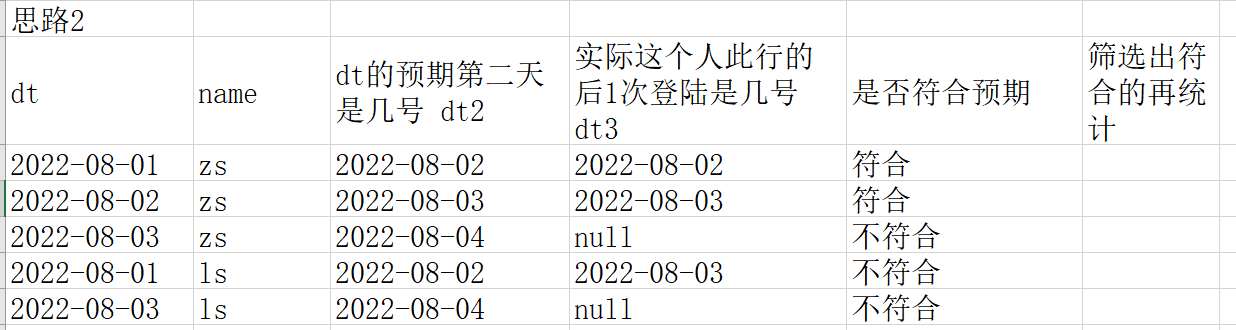
--核心代码->distinct->date_add(dt,N-1) as date2->lead(dt,N-1) over(partition by userid order by dt) as date3->where date2=date3->distinct3、以下为用户登陆游戏的日期,用一条sQL语句查询出连续三天登录的人员姓名
| name | date | | --- | --- | | 张三 | 2021-01-01 | | 张三 | 2021-01-02 | | 张三 | 2021-01-03 | | 张三 | 2021-01-02 | | 李四 | 2021-01-01 | | 李四 | 2021-01-02 | | 王五 | 2021-01-03 | | 王五 | 2021-01-02 | | 王五 | 2021-01-02 |
create table game(name string,  `date` string);insert overwrite table game values('张三','2021-01-01'),('张三','2021-01-02'),('张三','2021-01-03'),('张三','2021-01-02'),('张三','2021-01-07'),('张三','2021-01-08'),('张三','2021-01-09'),('李四','2021-01-01'),('李四','2021-01-02'),('王五','2021-01-03'),('王五','2021-01-02'),('王五','2021-01-02');with t1 as ( select distinct  name,date from game),     t2 as ( select *,                    row_number() over (partition by name order by date) rn         from t1),     t3 as ( select *,date_sub(date,rn) date2 from t2 )     select distinct name from t3 group by name,date2 having count(1)>=3;

--方案二select * from game;with t1 as ( select distinct name,`date` from game), t2 as ( select *, date_add(`date`,3-1) as date2, lead(`date`,3-1) over(partition by name order by `date`) as date3 from t1 )select distinct name from t2 where date2=date3;--方案二的写法2with t1 as ( select distinct name,`date` from game), t2 as ( select *, lead(`date`,3-1) over(partition by name order by `date`) as date3 from t1 )select distinct name from t2 where datediff(date3,`date`)=2 ;用户每日登陆脉脉会访问app不同的模块,现有两个表 表1记录了每日脉脉活跃用户的uid和不同模块的活跃时长 表2记录了脉脉所有注册用户的一些属性 表1:maimai.dau
| d | uid | module | active_duration | 列说明 | | --- | --- | --- | --- | --- | | 2020-01-01 | 1 | jobs | 324 | d:活跃的日期uid:用户的唯一编码module:用户活跃模块actre.duration:该模块下对应的活跃时长(单位:s) | | 2020-01-01 | 2 | feeds | 445 | | | 2020-01-01 | 3 | im | 345 | | | 2020-01-02 | 2 | network | 765 | | | 2020-01-02 | 3 | jobs | 342 | | | … | … | … | … | |
在过去一个月内,曾连续两天活跃的用户
-- 建表-- 表1 dau 记录了每日脉脉活跃用户的uid和不同模块的活跃时长create table dau(d string, uid int, module string, active_duration int);insert overwrite table dauvalues ('2020-01-01', 1, 'jobs', 324), ('2020-01-01', 2, 'feeds', 445), ('2020-01-01', 3, 'im', 345), ('2020-01-02', 2, 'network', 765), ('2020-01-02', 3, 'jobs', 342);select *from dau;with t1 as ( select DISTINCT d, uid from dau), t2 as ( select *, date_sub(d, (row_number() over (partition by uid order by d))) dis from t1 where d <= `current_date`() and d >= date_sub((`current_date`()), 30)),t3 as ( select uid, min(d) `开始日期`, max(d) `结束日期`, count(1) `连续登入天数` from t2 group by uid,dis having count(*) >= 2)select DISTINCT uid from t3 ;有一张表C_T(列举了部分数据)表示持卡人消费记录,表结构如下:
| CARD NER | VARCHAR2 | 卡号, | | --- | --- | --- | | C_MONTH | NUMBER | 消费月份, | | C_DATE | DATE | 消费日期, | | C_TYPEVAR | CHAR2 | 消费类型 | | C_ATM | NUMBER | 消费金额 |
每个月每张卡连续消费的最大天数(如卡在当月只有一次消费则为1)。 连续消费天数:指一楼时间内连续每天都有消费,同一天有多笔消费算一天消费,不能跨月份统计。
create table c_t( card_nbr string, c_month string, c_date string, c_type string, c_atm decimal);insert overwrite table c_t values (1,'2022-01','2022-01-01','网购',100), (1,'2022-01','2022-01-02','网购',200), (1,'2022-01','2022-01-03','网购',300), (1,'2022-01','2022-01-15','网购',100), (1,'2022-01','2022-01-16','网购',200), (2,'2022-01','2022-01-06','网购',500), (2,'2022-01','2022-01-07','网购',800), (1,'2022-02','2022-02-01','网购',100), (1,'2022-02','2022-02-02','网购',200), (1,'2022-02','2022-02-03','网购',300), (2,'2022-02','2022-02-06','网购',500), (2,'2022-02','2022-02-07','网购',800);with t1 as (select distinct card_nbr,c_month,c_date from c_t), t2 as (select *,row_number() over (partition by card_nbr,c_month order by c_date) rn from t1 ), t3 as (select *,date_sub(c_date,rn) dt2 from t2 ), t4 as (select dt2,card_nbr,c_month,count(1) as cnt from t3 group by dt2,card_nbr,c_month), t5 as ( select *,row_number() over (partition by card_nbr,c_month order by cnt desc) as rn from t4)select card_nbr,c_month,cnt from t5 where rn=1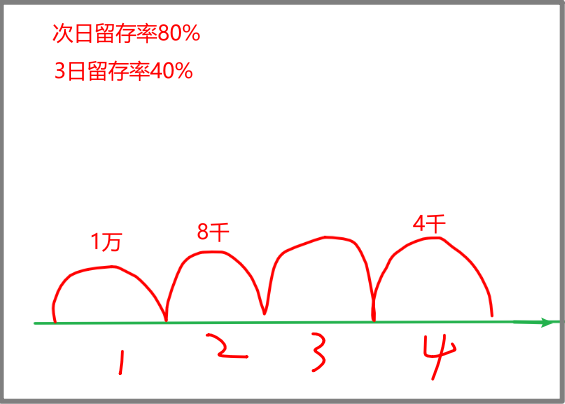
- 核心代码
-> where 日期 in (首日,1天后,7天后)-> group by 用户->count(if(日期=首日,1,null)) as cnt count(if(日期=1天后,1,null)) as cnt2 count(if(日期=7天后,1,null)) as cnt8->having cnt>0->count(user_id) as 首日总数 count(if(cnt2>0,1,null)) as 次日留存数 count(if(cnt8>0,1,null)) as 7日留存数->次日留存数/首日总数 as 次日留存率 7日留存数/首日总数 as 7日留存率- 先按用户分组,得到每个用户的各相关日期的登录情况。
select cuid, count(if(event_day='2020-04-01',1,null)) as cnt, count(if(event_day='2020-04-02',1,null)) as cnt2, count(if(event_day='2020-04-08',1,null)) as cnt8 from tb_cuid_1d --提前过滤数据 where event_day in ('2020-04-01','2020-04-02','2020-04-08')group by cuid-- 2020-04-01必须登录,剔除掉2020-04-01没登录的having cnt>0- 效果如下

- 再对上面的用户汇总
select count(cnt) as uv, count(if(cnt2!=0,1,null)) as uv2, count(if(cnt8!=0,1,null)) as uv8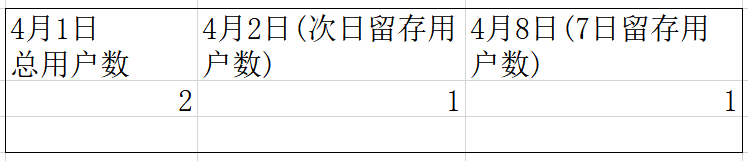
- 最后再用 【后续日期的留存数】除以【首日总数】,就是【留存率】
- 方案二
select count(a.cuid) uv, count(b.cuid) uv2, count(c.cuid) uv7from (select distinct event_day, cuid from tb_cuid_1d where event_day='首日') as aleft join (select distinct event_day, cuid from tb_cuid_1d where event_day='次日') as b on a.cuid=b.cuidleft join (select distinct event_day, cuid from tb_cuid_1d where event_day='7日后') as c on a.cuid=c.cuid;腾讯视频号游戏直播
Section titled “腾讯视频号游戏直播”表:tableA
| ds(日期) | device | user_id | is_active | | --- | --- | --- | --- | | 2020-03-01 | ios | 0001 | 0 | | 2020—0301 | ios | 0002 | 1 | | 2020-03-01 | android | 0003 | 1 | | 2020-03-02 | ios | 0001 | 0 | | 2020-03-02 | ios | 0002 | 0 | | 2020-03-02 | android | 0003 | 1 |
20200301的ios设备用户活跃的次日留存率是多少?
use test_sql;set hive.exec.mode.local.auto=true;--腾讯视频号游戏直播drop table if exists tableA;create table tableA(ds string comment '(日期)' ,device string,user_id string,is_active int) ;insert overwrite table tableA values('2020-03-01','ios','0001',0),('2020-03-01','ios','0002',1),('2020-03-01','ios','0004',1),('2020-03-01','android','0003',1),('2020-03-02','ios','0001',0),('2020-03-02','ios','0002',0),('2020-03-02','android','0003',1),('2020-03-02','ios','0005',1) ,('2020-03-02','ios','0004',1) ;--方案1,过程见下面的顺序编号with t1 as ( select user_id, --3-一个用户如果在'2020-03-01'活跃,则cnt1>0 count(if(ds = '2020-03-01', 1, null)) cnt1, --4-一个用户如果在'2020-03-02'活跃,则cnt2>0 count(if(ds = '2020-03-02', 1, null)) cnt2 from tableA --1-预先全局过滤 where device = 'ios' and is_active = 1 and ds in ('2020-03-01', '2020-03-02') --2-按用户分组 group by user_id --6-只筛选'2020-03-01'活跃的用户,他在'2020-03-02'是否活跃,看cnt2=0则不活跃,>0则活跃 having cnt1 > 0)select count(cnt1) sum1,--'2020-03-01'的活跃数 count(if(cnt2 > 0, user_id, null)) sum2,----并且在次日依然活跃的用户数 count(if(cnt2 > 0, user_id, null)) / count(cnt1) rate--次日留存率from t1;有两张表
create table if not exists tb_cuid_1d(    cuid         string comment '用户的唯一标识',    os           string comment '平台',    soft_version string comment '版本',    event_day    string comment '日期',    timestamp    int comment '用户访问时间戳',    duration     decimal comment '用户访问时长',    ext          array<string> comment '扩展字段');insert overwrite table tb_cuid_1d values (1,'android',1,'2020-04-01',1234567,100,`array`('')), (1,'android',1,'2020-04-02',1234567,100,`array`('')), (1,'android',1,'2020-04-08',1234567,100,`array`('')), (2,'android',1,'2020-04-01',1234567,100,`array`('')), (3,'android',1,'2020-04-02',1234567,100,`array`(''));
create table if not exists tb_account_1d(    cuid      string comment '用户的唯一标识',    uid       string comment '登入用户账号名',    event_day string comment '日期');
写出用户表 tb_cuid_1d的 20200401 的次日、次7日留存的具体HQL : 一条sql统计出以下指标 (4.1号uv,4.1号在4.2号的留存uv,4.1号在4.8号的留存uv);
--一个理解简单,但是性能不快的做法select count(a.cuid) uv, count(b.cuid) uv2, count(c.cuid) uv7from (select distinct event_day, cuid from tb_cuid_1d where event_day='2020-04-01') as aleft join (select distinct event_day, cuid from tb_cuid_1d where event_day='2020-04-02') as b on a.cuid=b.cuidleft join (select distinct event_day, cuid from tb_cuid_1d where event_day='2020-04-08') as c on a.cuid=c.cuid;--另一个理解稍微复杂,但是性能快的做法with t1 as ( select cuid, count(if(event_day='2020-04-01',1,null)) as cnt1, count(if(event_day='2020-04-02',1,null)) as cnt2, count(if(event_day='2020-04-08',1,null)) as cnt8 from tb_cuid_1d where event_day in ('2020-04-01','2020-04-02','2020-04-08') group by cuid having cnt1 >0), t2 as (select count(cuid) as uv1, count(if(cnt2 > 0, 1, null)) as uv2, count(if(cnt8 > 0, 1, null)) as uv7 from t1 )select *, uv2 / uv1 as `次日留存率`, uv7 / uv1 as `7日留存率`from t2分组内top前几
Section titled “分组内top前几”- 需求常见词:
- 【每组xxx内按yyy排序的前n个zzz】
- 【每组xxx内按yyy排序的第1个zzz】
- 【每组xxx内按yyy排序的最后1个zzz】
- 特点是yyy和zzz是不同的字段。
- 比如:班内按性别分组,组内按身高排序,的前3个学生姓名
- 公式:row_number() over(partition by 组名 order by yyy) as rn,再筛选rn<=N名
员工表结构 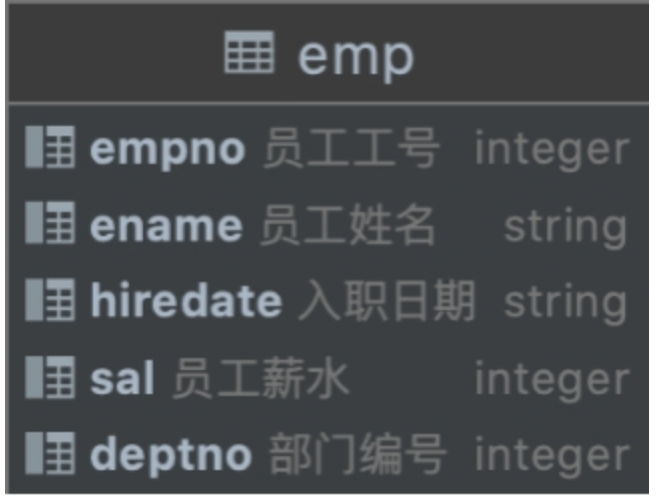 员工表数据
员工表数据 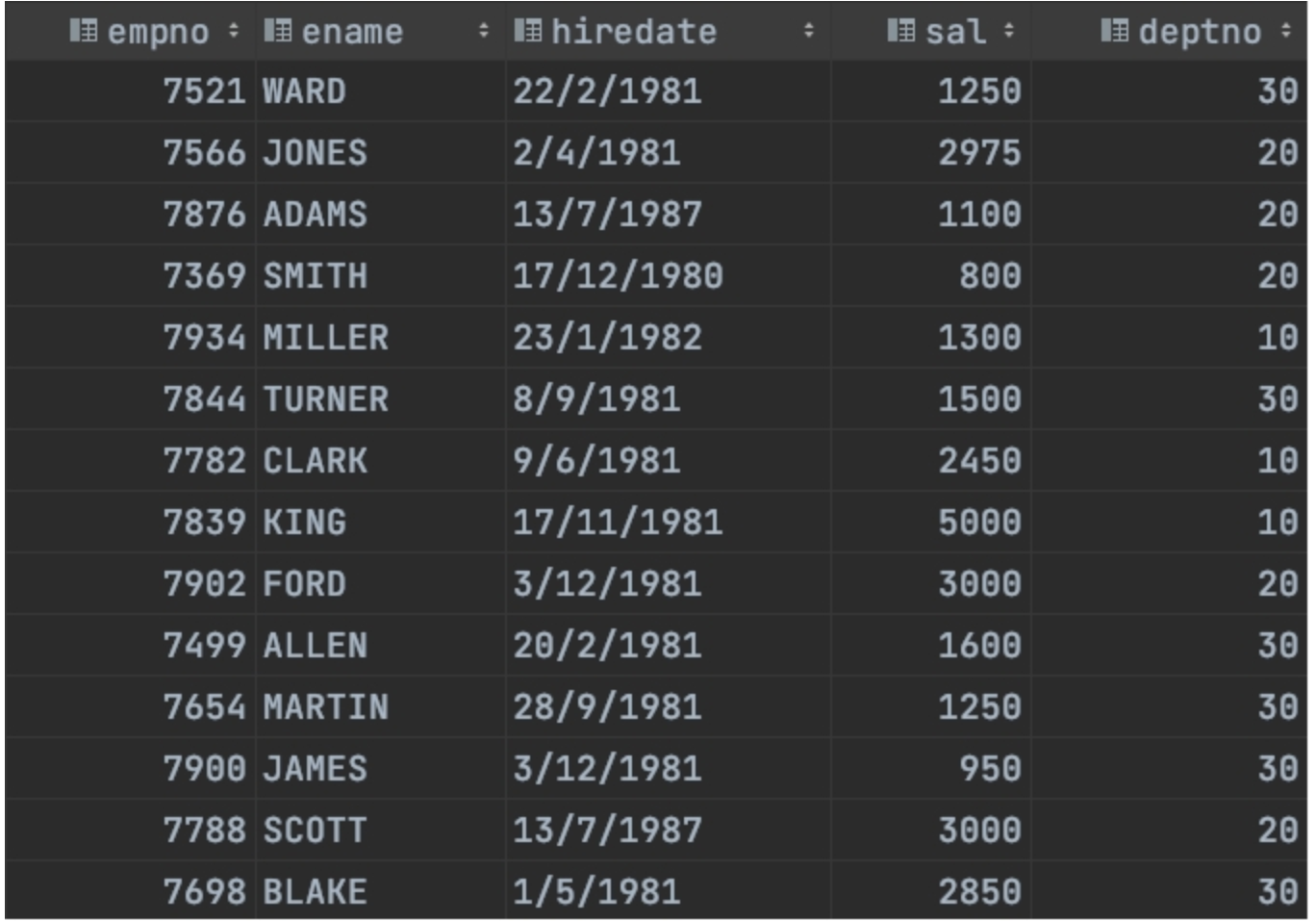 题目描述 求出每个部门工资最高的前三名员工,并计算这些员工的工资占所属部门总工资的百分比。 结果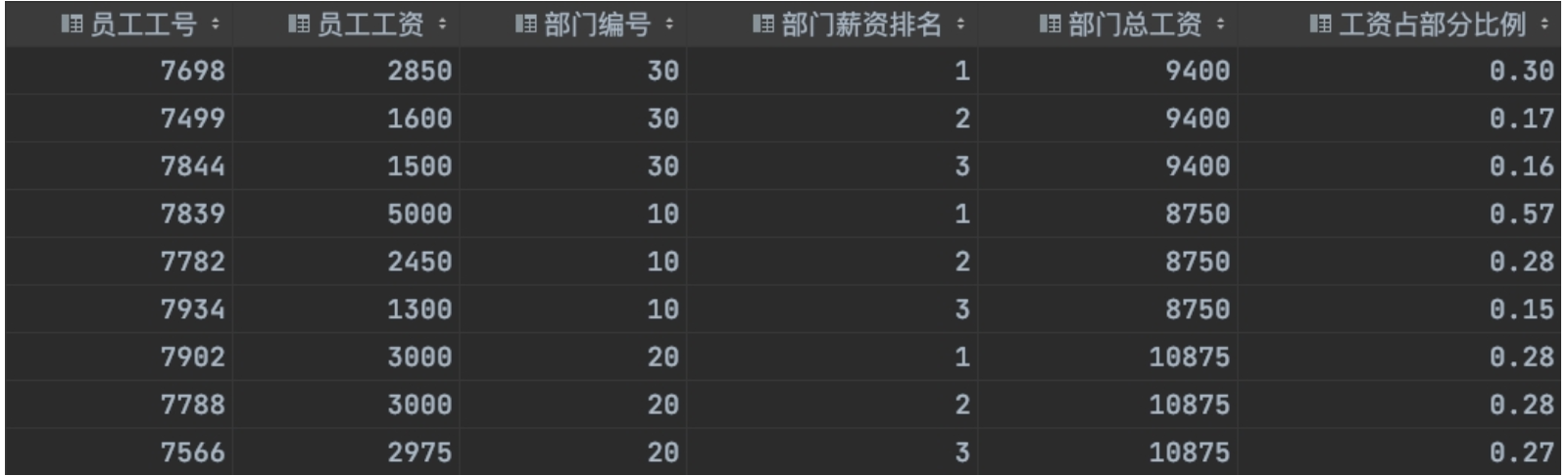
create table emp(empno string ,ename string,hiredate string,sal int ,deptno string);insert overwrite table emp values('7521', 'WARD', '1981-2-22', 1250, 30),('7566', 'JONES', '1981-4-2', 2975, 20),('7876', 'ADAMS', '1987-7-13', 1100, 20),('7369', 'SMITH', '1980-12-17', 800, 20),('7934', 'MILLER', '1982-1-23', 1300, 10),('7844', 'TURNER', '1981-9-8', 1500, 30),('7782', 'CLARK', '1981-6-9', 2450, 10),('7839', 'KING', '1981-11-17', 5000, 10),('7902', 'FORD', '1981-12-3', 3000, 20),('7499', 'ALLEN', '1981-2-20', 1600, 30),('7654', 'MARTIN', '1981-9-28', 1250, 30),('7900', 'JAMES', '1981-12-3', 950, 30),('7788', 'SCOTT', '1987-7-13', 3000, 20),('7698', 'BLAKE', '1981-5-1', 2850, 30);select * from emp;--求出每个部门工资最高的前三名员工,并计算这些员工的工资占所属部门总工资的百分比。select a.empno, a.sal, a.deptno, a.rn, a.sum_sal, round(a.sal/a.sum_sal,2) as ratefrom(select *,--每个部门工资排名 row_number() over (partition by deptno order by sal desc) as rn,--每个部门的总工资 sum(sal) over(partition by deptno ) as sum_salfrom emp) awhere rn<=3;订单表,torder. 字段,user_id, order_id, ctime(10位时间戳),city id,sale_num,sku_id(商品) 问题:20201201至今每日订单量top10的城市及其订单量(订单量对order id去重)(在线写)
create table t_order (user_id string, order_id string, ctime string, city_id string, sale_num int , sku_id string) ;with t1 as (select to_date(ctime) cdate, city_id, count(distinct order_id) cnt from t_order where to_date(ctime) >= '2020-12-01' and to_date(ctime) <= `current_date`() group by to_date(ctime), city_id), t2 as (select *, row_number() over (partition by cdate order by cnt desc) rn from t1)select cdate, city_id, cntfrom t2where rn <= 10;- 窗口函数的最大特点是有over()关键字
- 聚合类的窗口函数
- sum() over()
- count/avg/max/min
- 排序类的窗口函数
- row_number,rank,dense_rank
- 偏移类的,跨行的
- lag / lead
- first_value/last_value
- ntile
Emp表的表数据如下:
| NAME | MONTH | AMT | | --- | --- | --- | | 张三 | 01 | 100 | | 李四 | 02 | 120 | | 王五 | 03 | 150 | | 赵六 | 04 | 500 | | 张三 | 05 | 400 | | 李四 | 06 | 350 | | 王五 | 07 | 180 | | 赵六 | 08 | 400 |
问题:请写出可以得到以下的结果SQL
| NAME | 总金额 | 排名 | 占比 | | --- | --- | --- | --- | | 赵六 | 900 | 1 | 40.91% | | 张三 | 500 | 2 | 22.73% | | 李四 | 470 | 3 | 21.36% | | 王五 | 330 | 4 | 15.00% |
create table emp(name string , month string, amt int);insert overwrite table emp values ('张三', '01', 100), ('李四', '02', 120), ('王五', '03', 150), ('赵六', '04', 500), ('张三', '05', 400), ('李四', '06', 350), ('王五', '07', 180), ('赵六', '08', 400);--rank 1224--dense_rank 1223with t1 as (select name, sum(amt) as sum_amt from emp group by name), t2 as ( select name, sum_amt, row_number() over (order by sum_amt desc) rn, sum_amt/sum(sum_amt) over () as rate from t1 )select name, sum_amt, rn, concat(round(rate*100,2),'%') rate from t2题目描述 在第一题员工表的基础上,统计每年入职总数以及截至本年累计入职总人数。 截至本年累计入职总人数=本年总入职人数 + 本年之前所有年的总入职人数之和 结果 
select *, sum(cnt) over (order by year1) cnt2from(select year(hiredate) as year1, count(1) as cntfrom empgroup by year(hiredate)) a;join系列
Section titled “join系列”【区分 inner /left / right / full / left semi / left anti join 的特点】 有以下银行信息表
use interview_db;set hive.exec.mode.local.auto=true;drop table if exists all_users;create table all_users( id int comment '用户id', name string comment '用户姓名', sex string comment '性别', age int comment '年龄') comment '银行用户信息表';insert overwrite table all_users values(1,'张三','男',20),(2,'李四','男',29),(3,'王五','男',21),(4,'赵六','女',28),(5,'田七','女',22);drop table if exists black_list;create table black_list( user_id int comment '用户编号', type string comment '风控类型')comment '银行黑名单信息表';insert overwrite table black_list values(1,'诈骗'),(2,'逾期'),(3,'套现');left join
Section titled “left join”使用left join对所有用户,如果也在黑名单中,则标记为YES,否则标记为NO。
| id | name | sex | age | flag | | --- | --- | --- | --- | --- | | 1 | 张三 | 男 | 20 | YES | | 2 | 李四 | 男 | 29 | YES | | 3 | 王五 | 男 | 21 | YES | | 4 | 赵六 | 女 | 28 | NO | | 5 | 田七 | 女 | 22 | NO |
select a.*, if(b.user_id is not null, 'YES', 'NO') flagfrom all_users aleft join black_list bon a.id = b.user_id;right join
Section titled “right join”对上面的问题,使用right join再做一次。
| id | name | sex | age | flag | | --- | --- | --- | --- | --- | | 1 | 张三 | 男 | 20 | YES | | 2 | 李四 | 男 | 29 | YES | | 3 | 王五 | 男 | 21 | YES | | 4 | 赵六 | 女 | 28 | NO | | 5 | 田七 | 女 | 22 | NO |
select b.*, if(a.user_id is not null, 'YES', 'NO') flagfrom black_list aright join all_users bon a.user_id = b.id;left semi join
Section titled “left semi join”使用left semi join对所有用户,如果也在黑名单中,则挑选出来。
| id | name | sex | age | | --- | --- | --- | --- | | 1 | 张三 | 男 | 20 | | 2 | 李四 | 男 | 29 | | 3 | 王五 | 男 | 21 |
select a.*from all_users aleft semi join black_list bon a.id = b.user_id;left anti join
Section titled “left anti join”使用left anti join对所有用户,如果不在黑名单中,则挑选出来。
| id | name | sex | age | | --- | --- | --- | --- | | 4 | 赵六 | 女 | 28 | | 5 | 田七 | 女 | 22 |
select a.*from all_users aleft anti join black_list bon a.id = b.user_id;full join
Section titled “full join”--用户的存款金额。drop table if exists deposit;create table deposit ( user_id int comment '用户id', amount int comment '存款金额')comment '用户最新银行存款信息表';insert overwrite table deposit values(1,2000),(2,2900),(3,2100);--用户的负债金额。drop table if exists debt;create table debt ( user_id int comment '用户id', amount int comment '负债金额')comment '用户最新银行负债信息表';insert overwrite table debt values(3,3400),(4,2800),(5,2200);使用full join,展示用户的存款金额和负债金额。
| user_id | deposit_amount | debt_amount | | --- | --- | --- | | 1 | 2000 | 0 | | 2 | 2900 | 0 | | 3 | 2100 | 3400 | | 4 | 0 | 2800 | | 5 | 0 | 2200 |
select coalesce(a.user_id, b.user_id) as user_id, coalesce(a.amount, 0) as deposit_amount, coalesce(b.amount, 0) as debt_amountfrom deposit afull join debt bon a.user_id = b.user_id;【考察full join】 1、某个游戏中的元宝分为,付费元宝和免费元宝。玩家购买商城道具时候,可以使用付费元宝也可以使用免费元宝。请使用HIve SQL语句计算出2021-01-01至2021-01-07期间各个角色当日消耗元宝的付费免费比例(付费免费比 = 付费元宝消耗量 / 免费元宝消耗量)。 现有表结构如下:
| desc | dm_paid_buy; | | --- | --- | | #dm_paid_buy | 角色使用付费元宝购买商城道具时候记录一条 |
| time | bigint | #购买的时间戳 | | --- | --- | --- | | server_id | string | #服务器ID | | role_id | int | #角色ID | | cost | int | #购买对应道具消耗的付费元宝数量 | | item_id | int | #购买对应道具的id | | amount | int | #购买对应道具的数量 | | p_date | string | #登录日期,yyyy-MM-dd |
| desc | dm_free_buy; | | --- | --- | | #dm_free_buy | 角色使用免费元宝购买商城道具时候记录一条 |
| time | bigint | #购买的时间戳 | | --- | --- | --- | | server_id | string | #服务器ID | | role_id | int | #角色ID | | cost | int | #购买对应道具消耗的免费元宝数量 | | item_id | int | #购买对应道具的id | | amount | int | #购买对应道具的数量 | | p_date | string | #登录日期,yyyy-MM-dd |
示例: 结果输出
| p_date | server_id | role_id | 付费免费比 | | --- | --- | --- | --- | | 2021-01-01 | 123 | 10098 | 0 | | 2021-01-01 | 120 | 10098 | 0.4 | | 2021-01-02 | 123 | 10098 | 0.2 |
use interview_db;set hive.exec.mode.local.auto=true;create table if not exists dm_paid_buy( `time` bigint comment '#购买的时间戳', server_id string comment '#服务器ID', role_id int comment '#角色ID', cost int comment '#购买对应道具消耗的付费元宝数量', item_id int comment '#购买对应道具的id', amount int comment '#购买对应道具的数量', p_date string comment '#登录日期, yyyy-MM-dd') comment '角色使用付费元宝购买商城道具时候记录一条';insert overwrite table dm_paid_buy values(1234567,120,10098,2,3,4,'2021-01-01'),(1234567,120,10098,4,3,5,'2021-01-01'),(1234567,123,10098,3,3,2,'2021-01-02'),(1234567,123,10098,2,3,2,'2021-01-02');-- 查看表结构desc dm_paid_buy;create table if not exists dm_free_buy( `time` bigint comment '#购买的时间戳', server_id string comment '#服务器ID', role_id int comment '#角色ID', cost int comment '#购买对应道具消耗的免费元宝数量', item_id int comment '#购买对应道具的id', amount int comment '#购买对应道具的数量', p_date string comment '#登录日期, yyyy-MM-dd') comment '角色使用免费元宝购买商城道具时候记录一条';insert overwrite table dm_free_buy values(1234567,123,10098,8,3,4,'2021-01-01'),(1234567,123,10098,5,3,5,'2021-01-01'),(1234567,120,10098,6,3,4,'2021-01-01'),(1234567,120,10098,9,3,5,'2021-01-01'),(1234567,123,10098,18,3,2,'2021-01-02'),(1234567,123,10098,7,3,2,'2021-01-02');select coalesce(a.p_date, b.p_date) p_date, coalesce(a.server_id, b.server_id) server_id, coalesce(a.role_id, b.role_id) role_id, round(nvl(a.cost, 0) / b.cost, 3) as ratefrom (select p_date, server_id, role_id, sum(cost) cost from dm_paid_buy where p_date >= '2021-01-01' and p_date <= '2021-01-07' group by p_date, server_id, role_id) afull join (select p_date, server_id, role_id, sum(cost) cost from dm_free_buy where p_date >= '2021-01-01' and p_date <= '2021-01-07' group by p_date, server_id, role_id) b on a.p_date=b.p_date and a.server_id=b.server_id and a.role_id=b.role_id;join优化
Section titled “join优化”通用口诀:先用where或group by减少数据量,再join
--优化前,慢:select b.userid. b.username, sum(xx), count(xx)from a【比如交易明细事实表】join b【比如客户维度信息表】on a.userid=b.useridwhere b.yy<条件group by b.userid.b.usernamehaving count(a.xx) >10;--优化后,快:select b.userid. b.username, s, cnt --【提前对a减少数据量】from (select userid, sum(xx) s, count(xx) cnt from a group by userid having count(a.xx) >10)a --【提前对b减少数据量】join (select * from b where b.yy<条件) bon a.userid=b.userid;数据模型如下: 表T1的数据结构:
| 字段英文名 | 字段中文名 | 类型 | 主键标志 | 注释 | | --- | --- | --- | --- | --- | | Rec_no | 记录号 | CHAR(3) | Y | | | Ci_no | 客户号 | CHAR(6) | N | | | Cust_Type | 客户类型 | CHAR(2) | N | | | Cre_dt | 开户日期 | Date | N | | | Cus_sts | 客户状态 | Char(1) | N | Y-正常 N-无效 |
表T1的数据
| Rec_no | ci_no | cust_type | cre_dt | cus_sts | | --- | --- | --- | --- | --- | | 123 | 111111 | 01 | 2010-11-15 | Y | | 234 | 222222 | 02 | 2011-09-01 | Y | | 345 | 333333 | 02 | 2012-01-09 | Y | | 456 | 444444 | 01 | 2012-09-08 | Y |
表T2的数据结构:
| 字段英文名 | 字段中文名 | 类型 | 主键标志 | 注释 | | --- | --- | --- | --- | --- | | Ci_no | 客户号 | CHAR(6) | Y | | | AC_no | 客户账号 | CHAR(9) | Y | | | Bal | 账号余额 | DECIMAL(15,2) | N | |
表T2的数据:
| Ci_no char(6) | Ac_no char(9) | Bal decimal(15,2) | | --- | --- | --- | | 222222 | 123456888 | 1000.28 | | 222222 | 123456999 | 886 | | 333333 | 123454321 | 5000 |
请编写sql统计在9月份开户且账户余额不为0的有效客户数。(8分)
create table T1(    rec_no    int,    ci_no     int,    cust_type string,    cre_dt    string,    cus_sts   string);insert overwrite table T1 values(123,111111,'01','2010-11-15','Y'),(234,222222,'02','2011-09-01','Y'),(345,333333,'02','2012-01-09','Y'),(456,444444,'01','2012-09-08','N');select * from T1;
create table T2(    ci_no     int,    ac_no string,    bal    decimal(7,2));insert overwrite table T2 values(222222,'123456789',1000.28),(222222,'123456999',886),(333333,'123454321',5000.00);select * from T2;-- 传统的写法。select count(distinct t1.ci_no) as cntfrom t1join t2 on t1.ci_no=t2.ci_nowhere month(t1.cre_dt)=9and t1.cus_sts='Y'and bal>0;-- 方案2select count(t1.ci_no) as cntfrom (select * from t1 where month(cre_dt)=9 and cus_sts='Y') t1join (select ci_no from t2 group by ci_no having sum(bal)>0) t2on t1.ci_no=t2.ci_no;
带条件的聚合统计
Section titled “带条件的聚合统计”- 一般的做法是group by xx,yy 再多次的sum(if(…))
- 好处是避免多次加载表,一次性得到多个指标,可以只加载一次表就得到多个指标。
要求:编写SQL能运行,数据正确且符合规范,如遇到自定义函数或不记得的函数可以用XX代替 1.已知有如下两个表sale:字段如下
Create table sale_order( Order_id bigint comment '订单ID', User_id bigint comment '用户ID', Order_status int, Create_time string, Last_update_time string, Product_id bigint, Product_num bigint);用户注册表:
Create table user_info( user_id bigint comment'用户ID,唯一主键', sex string. age int);问题:用一条SQL生成完整的用户画像表,包含如下字段: user_id, sex, age, d7order_num, d14_order_num,后面两个字段分别为近7天订单数量,近14天订单数量。
create table sale_order( order_id bigint comment '订单ID', user_id bigint comment '用户ID', order_status int , create_time string, last_update_time string, product_id bigint, product_num bigint);create table user_info( user_id bigint comment '用户ID,唯一主键', sex string, age int);select u.user_id, s.d7order_num, s.d14order_numfrom user_info uleft join (select user_id, count(if(create_time >= '7天前' and create_time <= '今天', order_id,null)) as d7order_num, count(if(create_time >= '14天前' and create_time <= '今天', order_id,null)) as d14order_num from sale_order where create_time >= '14天前' group by user_id) s on u.user_id = s.user_id;- 查询课程编号“2”的成绩比课程编号“1”低的所有同学的学号、姓名。
- 【这是行转列的衍生题】
create table student(sid int, sname string, gender string, class_id int);insert overwrite table studentvalues (1, '张三', '女', 1), (2, '李四', '女', 1), (3, '王五', '男', 2);select * from student;create table course (cid int, cname string, teacher_id int);insert overwrite table coursevalues (1, '生物', 1), (2, '体育', 1), (3, '物理', 2);select * from course;create table score (sid int, student_id int, course_id int, number int);insert overwrite table scorevalues (1, 1, 1, 58), (4, 1, 2, 50), (2, 1, 2, 68), (3, 2, 2, 89);select * from score;with t1 as( select student_id, sum(if(course_id=2,number,0)) as pe, --体育 sum(if(course_id=1,number,0)) as bio --生物from scoregroup by student_idhaving pe<bio)select sid, snamefrom t1join studenton t1.student_id = sid;explode爆炸函数
Section titled “explode爆炸函数”公式:用【lateral view】+【explode】将大字段拆解成小字段:
select 主表名.旧字段,视图名.新字段 from 主表名 lateral view explode(数组字段) 视图名 as 新字段名假设tableA , tableB , tableB
| qq号(字段名:qq) | 游戏(字段名:games) | | --- | --- | | 10000 | a_b_c | | 20000 | c_d |
tableA
| qq号(字段名:qq) | 游戏(字段名:game) | | --- | --- | | 10000 | a | | 10000 | b | | 10000 | c | | 20000 | c | | 20000 | d |
将tableB输出为tableA的格式;
use interview_db;set hive.exec.mode.local.auto=true;create table tableA(qq string, game string)insert overwrite table tableA values (10000, 'a'), (10000, 'b'), (10000, 'c'), (20000, 'c'), (20000, 'd');create table tableB(qq string, game string) ;insert overwrite table tableB values(10000, 'a_b_c'),(20000, 'c_d');select qq, tmp.gamefrom tableB lateral view explode(split(game, '_')) tmp as game;用户常驻城市信息表addr_info: uid, addr_list 数据示例: “001”,【“深圳,东莞,广州”】 “002”,【“深圳,佛山,广州”】 用户基本信息表user:uid,name,gender,birth ,addr_list 问题:常驻人数top10的城市,男女比例的人数分布情况,要求结果如下: 城市名称,排名,男性人数,女性人数 “北京”, 1, 20008, 25005 “深圳”, 2, 23408, 30005
use interview_db;set hive.exec.mode.local.auto=true;drop table if exists user_info;create table user_info( uid string, name string, gender string, birth string, ----数组array,map,struct都是复杂类型 addr_list array<string>);insert overwrite table user_info values('001','zs','male','1995-01-01',array('深圳','东莞','广州')),('002','ls','female','1996-01-01',array('深圳','佛山','广州'));with t1 as ( select uid,gender,addr from user_info lateral view explode(addr_list) view1 as addr) , t2 as ( select t1.addr, --统计每个城市的人数,方便后续排序 count(t1.uid) cnt, count(if(gender='male',t1.uid,null)) cnt_male, --男性人数 count(if(gender='female',t1.uid,null)) cnt_female--男性人数 from t1 group by t1.addr )select addr, row_number() over (order by cnt desc) rn, cnt_male, cnt_femalefrom t2 ;CTE语句(with as语句)
Section titled “CTE语句(with as语句)”擅长解决,步骤很多,逻辑非常复杂的需求。 语法:
with 临时表名1 as ( select 语句1), 临时表名2 as ( select 语句2【可以直接用前面的临时表名】),。。。。。。select * from 临时表名n一款MMORPG游戏有一个每日任务设计,完成不同任务可以获得不同的活跃度奖励。当日活跃度累计超过100,就可以获得一个活跃宝箱(获得宝箱后玩家仍然会继续参加任务获得活跃度,但不会有额外奖励)。活跃度会每日清零,活跃任务也是每日刷新。现有表结构如下 表dm_activity_di(当角色每完成一个任务时候,记录一条获取活跃度的日志):
| | | | | --- | --- | --- | | role_id | int | #角色id | | task_id | int | #本次完成的任务id | | activity_add | int | #本次角色获取的活跃度 | | p_date | string | #日志触发的日期, yyyy-MM-dd | | time | bigint | #该日志的触发时间戳 |
drop table dm_activity_di;create table if not exists dm_activity_di( role_id string comment '#角色id', task_id int comment '#本次完成的任务id', activity_add int comment '#本次角色获取的活跃度', p_date string comment '#日志触发的日期, yyyy-MM-dd', time string comment '#该日志的触发时间戳') comment '当角色每完成一个任务时候,记录一条获取活跃度的日志';insert overwrite table dm_activity_divalues ('小红', 12, 20, '2021-01-01', '2021-01-01 10:00:00'), ('小红', 13, 30, '2021-01-01', '2021-01-01 11:00:00'), ('小红', 1, 10, '2021-01-01', '2021-01-01 12:00:00'), ('小红', 3, 60, '2021-01-01', '2021-01-01 13:00:00'), ('小红', 6, 30, '2021-01-01', '2021-01-01 14:00:00'), ('小李', 17, 20, '2021-01-01', '2021-01-01 08:00:00'), ('小李', 14, 30, '2021-01-01', '2021-01-01 09:00:00'), ('小李', 3, 40, '2021-01-01', '2021-01-01 10:00:00'), ('小李', 5, 20, '2021-01-01', '2021-01-01 11:00:00'), ('小李', 1, 30, '2021-01-01', '2021-01-01 12:00:00'), ('小明', 8, 20, '2021-01-01', '2021-01-01 13:00:00'), ('小明', 4, 10, '2021-01-01', '2021-01-01 14:00:00'), ('小明', 5, 10, '2021-01-01', '2021-01-01 15:00:00'), ('小明', 31,50, '2021-01-01', '2021-01-01 16:00:00'), ('小明', 9, 30, '2021-01-01', '2021-01-01 17:00:00'), ('小明', 9, 20, '2021-01-01', '2021-01-01 18:00:00');1)统计一下2021-01-01当天,各个服务器的各个角色在完成各个任务时累积已获得的活跃度。 示例: 一个角色在一天内全部的活跃度获取日志
| role_id | task_id | activity_add | p_date | time | | --- | --- | --- | --- | --- | | 小红 | 12 | 20 | 2021-01-01 | 2021-01-01 10:00:00 | | 小红 | 13 | 30 | 2021-01-01 | 2021-01-01 11:00:00 | | 小红 | 1 | 10 | 2021-01-01 | 2021-01-01 12:00:00 | | 小红 | 3 | 60 | 2021-01-01 | 2021-01-01 13:00:00 | | 小红 | 6 | 30 | 2021-01-01 | 2021-01-01 14:00:00 |
结果输出
| role_id | task_id | activity_add | p_date | time | 累积获得的活跃度 | | --- | --- | --- | --- | --- | --- | | 小红 | 12 | 20 | 2021-01-01 | 2021-01-01 10:00:00 | 20 | | 小红 | 13 | 30 | 2021-01-01 | 2021-01-01 11:00:00 | 50 | | 小红 | 1 | 10 | 2021-01-01 | 2021-01-01 12:00:00 | 60 | | 小红 | 3 | 60 | 2021-01-01 | 2021-01-01 13:00:00 | 120 | | 小红 | 6 | 30 | 2021-01-01 | 2021-01-01 14:00:00 | 150 |
select *, sum(activity_add) over (partition by p_date, role_id order by `time` ) sum1from dm_activity_di2)统计一下2021-01-01当天,角色获得活跃度宝箱时候所完成的任务数量分布。 示例:结果输出
| p_date | 获得宝箱时候的任务数量 | 角色数 | | --- | --- | --- | | 2021-01-01 | 4 | 2 | | 2021-01-01 | 5 | 1 |
【活跃度累计超过100】等价于【获得1个宝箱】 
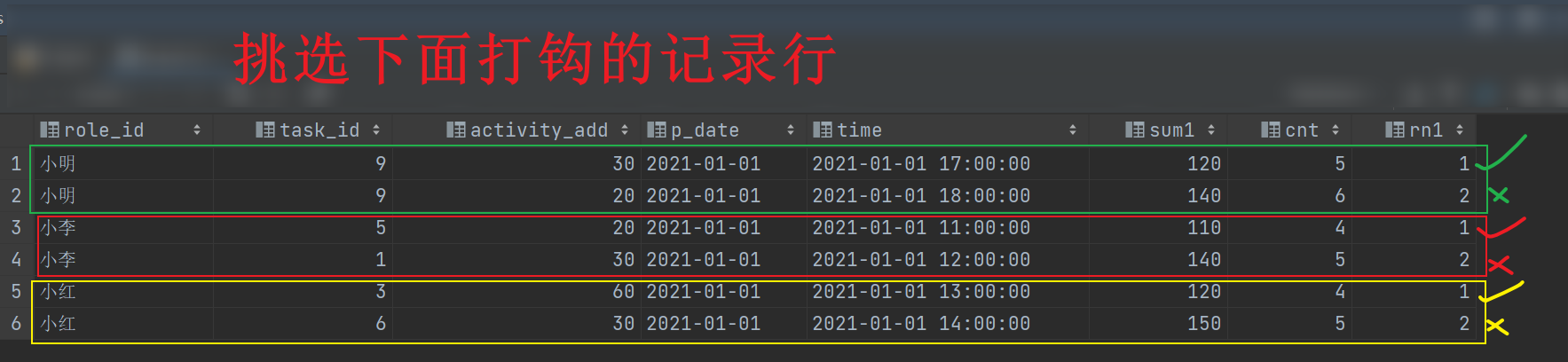

--步骤清晰法with t1 as (select *, sum(activity_add) over (partition by p_date, role_id order by `time` ) sum1 from dm_activity_di), t2 as (select *, row_number() over (partition by p_date,role_id order by `time`) cnt from t1), t3 as (select *from t2 where sum1 > 100), t4 as (select *, row_number() over (partition by p_date,role_id order by sum1 ) as rn1 from t3), t5 as (select *from t4 where rn1 = 1)select p_date, cnt, count(role_id) as num_rolesfrom t5group by p_date, cnt;----简化写法select *, sum(activity_add) over (partition by p_date, role_id order by `time` ) `累积获得的活跃度`from dm_activity_di where role_id='小红';with t1 as ( select *, sum(activity_add) over (partition by p_date, role_id order by `time` ) sum1, --得到当前活跃度时,闯了几关, row_number() over (partition by p_date,role_id order by `time`) cnt from dm_activity_di) , t2 as ( select *, row_number() over (partition by p_date,role_id order by sum1 ) as rn1 from t1 where sum1>100 )select p_date,cnt, count(role_id) as num_rolesfrom t2 where rn1=1group by p_date,cnt;- 窗口函数+行转列+CTE语法
题目:有一个流水表,用户1在什么时间玩了什么游戏,
create or replace temporary view user_login(dtstatdate, qq, dteventtime, game)asvalues ("20220110", 1, '2022/1/10 0:04', "王者荣耀"), ("20220110", 1, '2022/1/10 0:04', "王者荣耀"), ("20220110", 1, '2022/1/10 10:14', "王者荣耀"), ("20220110", 1, '2022/1/10 11:02', "天刀"), ("20220110", 1, '2022/1/10 11:02', "天刀"), ("20220110", 1, '2022/1/10 12:14', "王者荣耀"), ("20220110", 2, '2022/1/10 10:13', "数码宝贝"), ("20220110", 2, '2022/1/10 15:58', "lol"), ("20220110", 2, '2022/1/10 17:11', "lol");SELECT * FROM user_login;需求:处理一下某个用户的玩游戏的先后顺序链条,按照时间排序后游戏相同的要合并 例子:AABBA需要合并成ABA 例子结果:
| dtstatdate | qq | time_set | game_set | | --- | --- | --- | --- | | 20220110 | 1 | 2022/1/10 0:04,2022/1/10 11:02,2022/1/10 12:14 | 王者荣耀,天刀,王者荣耀 | | 20220110 | 2 | 2022/1/10 10:13,2022/1/10 15:58 | 数码宝贝,lol |
代码:
with t1 as ( select *, --1-标记每天每用户,每次游戏的上次游戏是什么。目的是为了借助错位1行,对相同游戏去重复,间接合并相邻的2次游戏。 lag(game, 1, '') over (partition by dtstatdate,qq order by dteventtime) last from user_login), t2 as ( select dtstatdate, qq, dteventtime, game from t1 --2-借助错位1行,对相同游戏去重复,间接合并相邻的2次游戏。 where game != last ), t3 as ( --3-将时间和游戏,绑在一起合成整体。 select *, concat(dteventtime, '-', game) time_game from t2 ), t4 as ( --4-将上一步每个整体,装进一个数组容器中。 select dtstatdate, qq,collect_list(time_game) time_gamesfrom t3 group by dtstatdate, qq ), t5 as ( select dtstatdate, qq, --5-对上一步的数组容器中的每个整体进行排序, --具体是按照每个整体的前半部分也就是日期排序。 --array_sort函数,用法是对数组容器的每个元素两两之间比较排序,left, right就是每次两两之间比较的意思。 --负1表示左比右小,正1表示左比右大,零表示二者相等。 array_sort(time_games, (left, right) ->( case when split(left,'-')[0] < split(right,'-')[0] then -1 when split(left,'-')[0] > split(right,'-')[0] then 1 else 0 end) ) sorted_games from t4 ), t6 as ( select *, --6-上一步排好序的大数组容器中,每个元素是【时间-游戏名】整体,将大数组容器还原拆成2个小数组容器, -- 第1个数组中都是时间,第2个数组中都是游戏名。 -- transform函数用法是对数组每个元素进行转换。x名字随便取,表示每个元素。 transform(sorted_games, x->split(x, '-')[0]) time_array, transform(sorted_games, x->split(x, '-')[1]) games_array from t5 ), t7 as ( --7-将每个小数组容器的元素用字符串表示 select dtstatdate, qq,concat_ws(',', time_array) time_set,concat_ws(',', games_array) game_set from t6 )select * from t7 ;- 考验行转列
role_login
| 字段名 | 类型 | 含义 | | --- | --- | --- | | server_id | int | ‘服务器id’, | | pid | int | ‘用户平台id’, | | plosgn | int | ‘用户所属平台的id’, | | log_time | int | ‘登入时间戳’, | | ds | string | ‘日期’, | | gn | string | ‘游戏名’ |
role_login
| server_id | pid | plosgn | log_time | ds | gn | | --- | --- | --- | --- | --- | --- | | 3000001 | 510166 | 1 | 1626565553 | 2021-07-18 | A | | 3000001 | 510166 | 1 | 1626568224 | 2021-07-18 | A | | 3000001 | 510166 | 1 | 1626574517 | 2021-07-18 | B | | 3000001 | 510047 | 8 | 1626585497 | 2021-07-18 | C | | 3000001 | 510047 | 8 | 1626659972 | 2021-07-19 | D | | 3000008 | 510013 | 1 | 1626660317 | 2021-07-19 | D | | 3000008 | 510013 | 1 | 1626662251 | 2021-07-19 | T | | 3000001 | 782902 | 16 | 1626662577 | 2021-07-19 | Y | | 3000001 | 782902 | 16 | 1626662895 | 2021-07-19 | Y | | 3000001 | 782902 | 16 | 1626663542 | 2021-07-19 | Y | | 3000001 | 510062 | 7 | 1626663914 | 2021-07-19 | Y | | 3000001 | 510062 | 7 | 1626664080 | 2021-07-19 | Y |
列出在2021年5月有过登录,2021年6月没有登录,2021年7月又登录过游戏D的用户信息(需展示的字段为server_id,pid)
select server_id, pidfrom (select *, count(if(substr(ds, 0, 7) = '2021-05', 1, null)) over (partition by pid ) cnt1, count(if(substr(ds, 0, 7) = '2021-06', 1, null)) over (partition by pid ) cnt2, count(if(substr(ds, 0, 7) = '2021-07', 1, null)) over (partition by pid ) cnt3 from role_login where gn = 'D' and substr(ds, 0, 7) in ('2021-05', '2021-06', '2021-07') ) twhere cnt1 > 0 and cnt2 = 0 and cnt3 > 0;